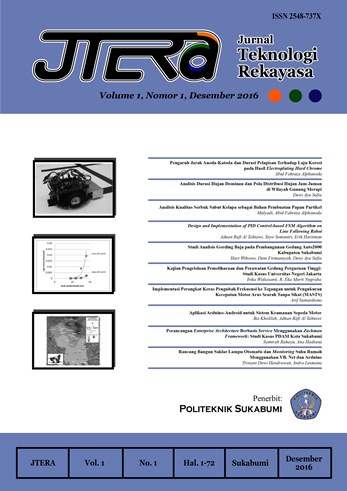

Aplikasi Arduino-Android untuk Sistem Keamanan Sepeda Motor
DOI:
https://doi.org/10.31544/jtera.v1.i1.2016.53-58Keywords:
sistem keamanan, Arduino, Android, bluetooth, sepeda motorAbstract
Sistem keamanan sepeda motor diperlukan untuk mengatasi peningkatan pencurian sepeda motor. Saat ini, solusi yang biasa dilakukan oleh pemilik sepeda motor hanya dengan memakai kunci ganda saja dimana pencuri sudah sangat menguasainya. Untuk itu diperlukan suatu sistem keamanan yang lebih baik. Dalam makalah ini, akan dipaparkan suatu sistem keamanan sepeda motor berbasis Arduino-Android. Sistem kemanan ini berbasis relai dan akan dikendalikan melalui smartphone dengan sistem operasi Android v4.4 (KitKat). Sistem komunikasi dirancang dengan menggunakan modul bluetooth HC-06 yang dapat diintegrasikan dengan papan mikrokontroler Arduino Uno. Detail perancangan sistem dijelaskan pada makalah ini. Hasil pengujian menunjukan jarak maksimal komunikasi bluetooth antara pengendali (smartphone) dengan sistem pada sepeda motor yaitu 10 m.
Downloads
References
Bagenda, D. N., Prasetya, Indra. “Prototype Sistem Keamanan dan Pengendalian Sepeda Motor Berbasis Mokrokontroller ATmega8535â€. Jurnal LPKIA, Vol.1 No.1, pp. 1-6, September 2014
Saleh, Robby, dkk. “Sistem Keamanan Motor Menggunakan Telephone Seluler Berbasis Komunikasi Dua Arahâ€. CommIT, Vol. 1 No. 1, pp. 1-9, Mei 2007
Kurniawan, M. T. “Rancang Bangun Sistem Pengaman Sepeda Motor Anti Malingâ€. Prosiding SENTIA, pp. E-102-E-107, Politeknik Negri Malang, 2009
Lingga Hartadi, Dani Sasmoko. “Sistem Keamanan Kendaraan Suzuki Smash Menggunakan ATmega 8 dengan Sensor Bluetooth Hc-06 Berbasis Androidâ€. ELKOM Jurnal Elektronika dan Komputer, Vol.8 No.1, pp. 7-18, April 2015
www.arduino.cc
https://aldrik.wordpress.com/2009/09/04/sistem-starter-elektrik-sepeda-motor
Downloads
Published
Issue
Section
License
Authors who publish with this journal agree to the following terms:
The copyright to this article is transferred to JTERA if and when the article is accepted for publication. The undersigned hereby transfers any and all rights in and to the paper including without limitation all copyrights to JTERA. The undersigned hereby represents and warrants that the paper is original and that he/she is the author of the paper, except for material that is clearly identified as to its original source, with permission notices from the copyright owners where required. The undersigned represents that he/she has the power and authority to make and execute this assignment. The copyright transfer form will be sent via email before the article published.
The corresponding author signs for and accepts responsibility for releasing this material on behalf of any and all co-authors. This agreement is to be signed by at least one of the authors who have obtained the assent of the co-author(s) where applicable. After submission of this agreement signed by the corresponding author, changes of authorship or in the order of the authors listed will not be accepted.